A Strong Ally of the United States in 2001 Agains the Taliban Is What
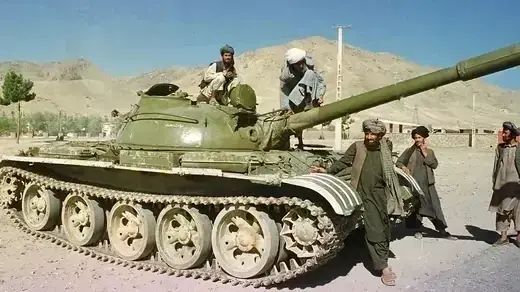
An Al-Qaeda, Taliban Nexus
The UN Security Quango adopts Resolution 1267, creating the so-called al-Qaeda and Taliban Sanctions Committee, which links the two groups equally terrorist entities and imposes sanctions on their funding, travel, and arms shipments. The UN move follows a menses of ascendancy for al-Qaeda and its leader, Osama bin Laden, who guided the terror group from Afghanistan and Peshawar, Islamic republic of pakistan, in the belatedly 1980s, to Sudan in 1991, and back to Afghanistan in the mid-1990s. The Taliban, which rose from the ashes of Transitional islamic state of afghanistan'due south mail-Soviet civil war, provide al-Qaeda sanctuary for operations.
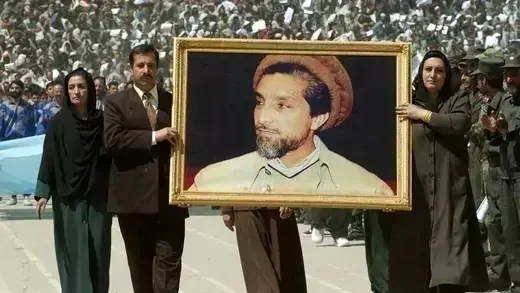
A Northern Alliance Assassination
Ahmad Shah Massoud, commander of the Northern Alliance, an anti-Taliban coalition, is assassinated by al-Qaeda operatives. The killing of Massoud, a master of guerilla warfare known as the Lion of the Panjshir, deals a serious blow to the anti-Taliban resistance. Terrorism experts believe his bump-off assured bin Laden protection by the Taliban after the 9/11 attacks. Expert Peter Bergen later calls Massoud's bump-off "the curtain raiser for the attacks on New York City and Washington, DC."

Terrorists Strike the U.S.
Al-Qaeda operatives hijack four commercial airliners, crashing them into the World Trade Middle in New York and the Pentagon in Washington, DC. A fourth plane crashes in a field in Shanksville, Pennsylvania. Close to three thousand people dice in the attacks. Although Transitional islamic state of afghanistan is the base for al-Qaeda, none of the xix hijackers are Afghan nationals. Mohammed Atta, an Egyptian, led the group, and 15 of the hijackers originated from Saudi arabia. U.S. President George West. Bush vows to "win the war confronting terrorism," and later zeros in on al-Qaeda and bin Laden in Afghanistan. Bush-league somewhen calls on the Taliban government to "deliver to the United states authorities all the leaders of al-Qaeda who hide in your land," or share in their fate.
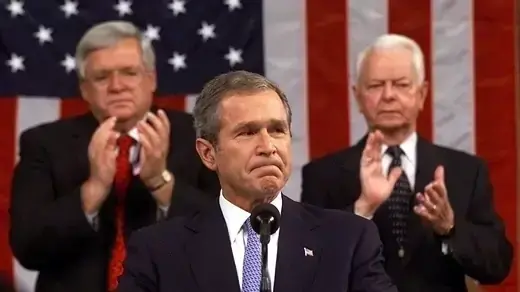
A War Ground
President Bush-league signs into constabulary a joint resolution authorizing the utilise of strength against those responsible for attacking the U.s.a. on September 11. This articulation resolution will afterwards exist cited by the Bush-league administration every bit legal rationale for its conclusion to take sweeping measures to combat terrorism, including invading Afghanistan, eavesdropping on U.S. citizens without a court order, and standing up the detention military camp at Guantanamo Bay, Republic of cuba.
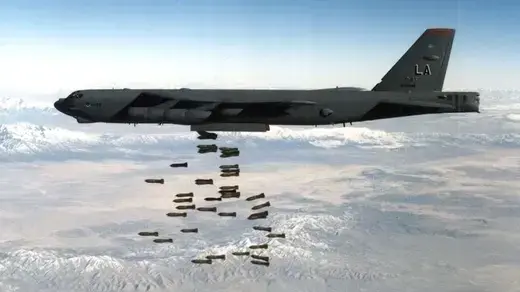
The Opening Salvo
The U.South. military, with British support, begins a bombing campaign confronting Taliban forces, officially launching Operation Enduring Freedom. Australia, Canada, French republic, and Frg pledge future support. The war's early phase [PDF] mainly involves U.S. air strikes on al-Qaeda and Taliban forces that are assisted by a partnership of almost i g U.South. special forces, the Northern Alliance, and ethnic Pashtun anti-Taliban forces. The first wave of conventional ground forces arrives twelve days later. Most of the ground combat is between the Taliban and its Afghan opponents.
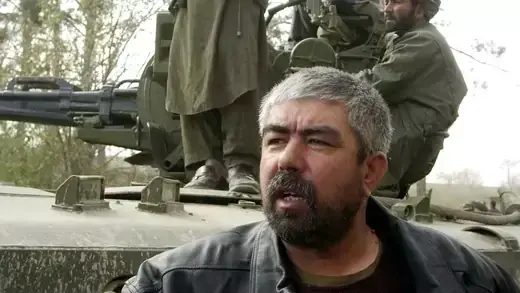
The Taliban in Retreat
The Taliban regime unravels speedily after its loss at Mazar-east-Sharif on November 9, 2001, to forces loyal to Abdul Rashid Dostum, an ethnic Uzbek war machine leader. Over the next week Taliban strongholds crumble later on coalition and Northern Brotherhood offensives on Taloqan (Nov 11), Bamiyan (November 11), Herat (Nov 12), Kabul (November thirteen), and Jalalabad (November 14). On November 14, the United nations Security Council passes Resolution 1378, calling for a "central role" for the United nations in establishing a transitional administration and inviting member states to send peacekeeping forces to promote stability and aid delivery.
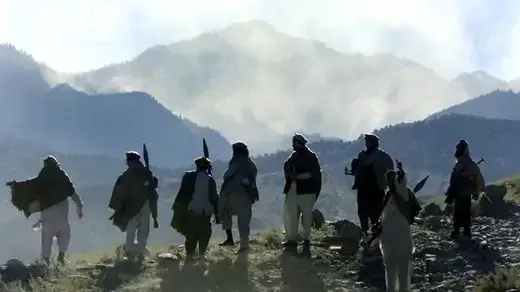
Bin Laden Escapes
Later tracking al-Qaeda leader bin Laden to the well-equipped Tora Bora cave complex southeast of Kabul, Afghan militias appoint in a fierce two-calendar week boxing (December 3 to 17) with al-Qaeda militants. Information technology results in a few hundred deaths and the eventual escape of bin Laden, who is thought to take left for Pakistan on horseback on December 16—merely a twenty-four hour period before Afghan forces capture twenty of his remaining men. Despite intelligence pointing to bin Laden'southward presence in Tora Bora, U.S. forces exercise not lead the assault, which is carried out by a ragtag Afghan contingent led by Hazrat Ali, Haji Zaman, and Haji Zahir. Some critics will afterwards question why U.Due south. forces did not take a more assertive role in the date.
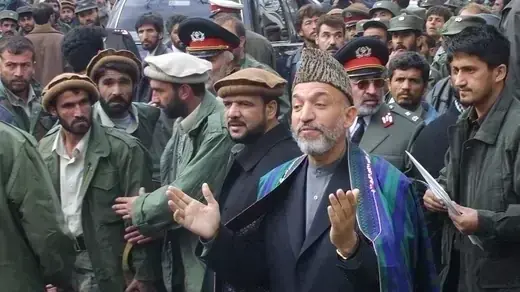
An Interim Government
After the fall of Kabul in November 2001, the United Nations invites major Afghan factions, near prominently the Northern Alliance and a grouping led past the quondam king (only not the Taliban), to a briefing in Bonn, Germany. On December 5, 2001, the factions sign the Bonn Agreement, endorsed by UN Security Council Resolution 1383. The agreement, reportedly reached with substantial Iranian diplomatic assistance because of Islamic republic of iran's back up for the Northern Alliance faction, installs Hamid Karzai equally interim administration head, and creates an international peacekeeping strength to maintain security in Kabul. The Bonn Understanding is followed by Un Security Council Resolution 1386 on December 20, which establishes the International Security Assist Force, or ISAF.
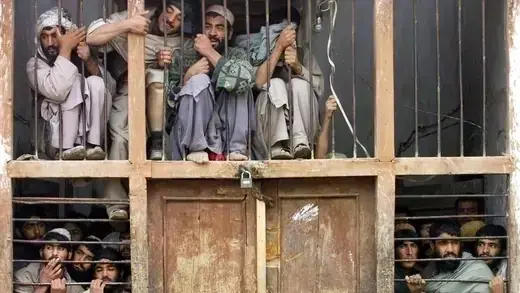
The Taliban Plummet
The end of the Taliban regime is generally tied to this engagement, when the Taliban surrender Kandahar [PDF] and Taliban leader Mullah Mohammed Omar flees the city, leaving it under tribal law administered by Pashtun leaders. Despite the official autumn of the Taliban, however, al-Qaeda leaders continue to hibernate out in the mountains.
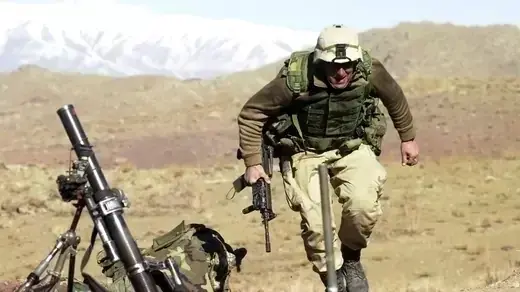
Operation Anaconda, the first major footing set on and the largest operation since Tora Bora, is launched against an estimated eight hundred al-Qaeda and Taliban fighters in the Shah-i-Kot Valley south of the city of Gardez (Paktia Province). About ii g U.S. and one thou Afghan troops battle the militants. Despite the operation'south size, nevertheless, Anaconda does non stand for a broadening of the war effort. Instead, Pentagon planners brainstorm shifting military and intelligence resources away from Transitional islamic state of afghanistan in the direction of Saddam Hussein's Republic of iraq, which is increasingly mentioned as a main U.S. threat in the "war on terror."
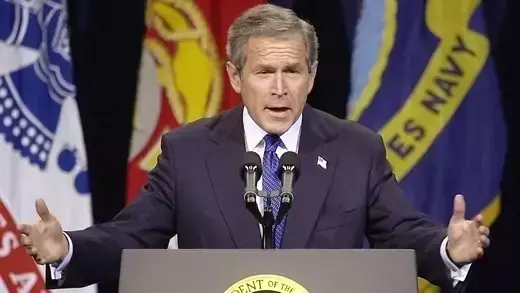
Reconstructing Afghanistan
President Bush-league calls for the reconstruction of Transitional islamic state of afghanistan in a speech at the Virginia Armed services Institute. "By helping to build an Afghanistan that is free from this evil and is a ameliorate place in which to live, we are working in the best traditions of George Marshall," he says, evoking the mail service-World War 2 Marshall Plan that revived Western Europe. But the United States and its allies do non come up shut to Marshall Plan-like reconstruction spending for Afghanistan. The U.Due south. Congress appropriates over $38 billion in humanitarian and reconstruction assistance to Afghanistan from 2001 to 2009.
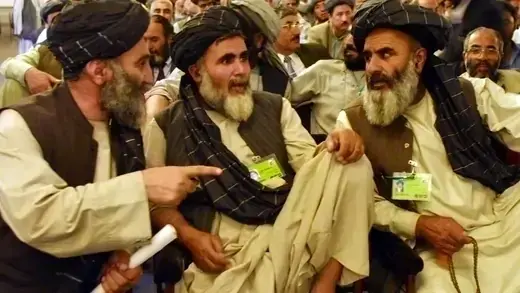
Transitional Regime Named
Chairman of the Interim Administration of Afghanistan Karzai is picked is picked to head the country's transitional government. His selection comes during an emergency loya jirga assembled in Kabul, attended by one,550 delegates (including about 200 women) from Afghanistan's 364 districts. Karzai, leader of the powerful Popalzai tribe of Durrani Pashtuns, returned to Afghanistan from Pakistan later the 9/11 attacks to organize Pashtun resistance to the Taliban. Some observers allege Karzai tolerates corruption by members of his clan and his government. The Northern Alliance, dominated by indigenous Tajiks, fails in its attempt to set up a prime ministership, but does succeed in checking presidential powers by assigning major authorities to the elected parliament, such as the ability to veto senior official nominees and to impeach a president.
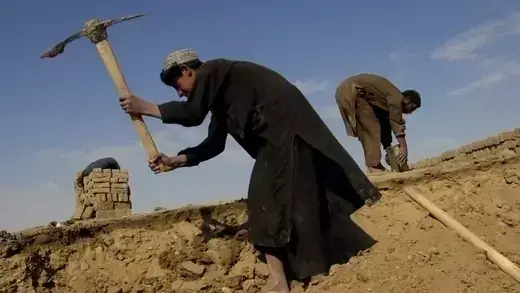
Establishing a Reconstruction Model
The U.S. war machine creates a civil affairs framework to coordinate redevelopment with the Un and nongovernmental organizations and to expand the say-so of the Kabul government. These then-chosen provincial reconstruction teams, or PRTs, are stood up first in Gardez in Nov, followed by Bamiyan, Kunduz, Mazar-e-Sharif, Kandahar, and Herat. Control for individual PRTs is eventually handed over to N Atlantic Treaty Organization (NATO) states. While credited with improving security for aid agencies, the model is non universally praised. Concern mounts that the PRT system lacks cardinal controlling potency, is disorganized, and creates what a U.Southward. Constitute of Peace report calls "an ad hoc approach" to security and development. Such criticism grows beyond the PRT program and becomes a common theme in the NATO war try, as a maze of national caveats restricts the activities of member forces. Critics fence this limits the coalition's effectiveness.
'Major Gainsay' Over
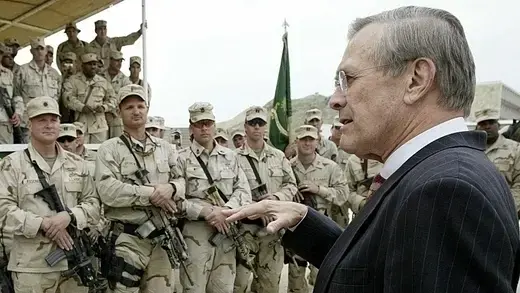
During a briefing with reporters in Kabul, U.S. Secretary of Defense Donald Rumsfeld declares an end to "major combat." The declaration coincides with President Bush-league's "mission accomplished" declaration of an terminate to fighting in Republic of iraq. Rumsfeld says President Bush-league, U.S. Central Command Chief Gen. Tommy Franks, and Afghan President Karzai "have concluded that we are at a signal where we conspicuously have moved from major combat activity to a period of stability and stabilization and reconstruction and activities." There are only eight thousand U.S. soldiers stationed in Afghanistan. Information technology is predicted that the transition from gainsay to reconstruction will open the door for many assist organizations, particularly European groups, that had aghast at sending troops, supplies, or other assistance.
An International Mission
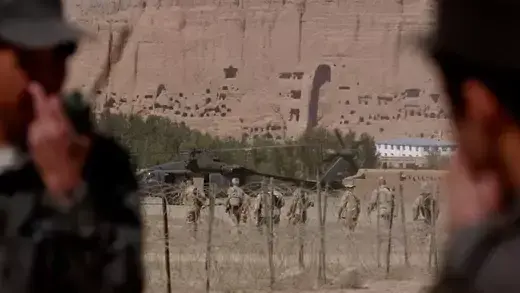
NATO assumes control of international security forces (ISAF) in Afghanistan, expanding NATO/ISAF's office across the country. It is NATO's first operational delivery outside of Europe. Originally tasked with securing Kabul and its surrounding areas, NATO expands in September 2005, July 2006, and October 2006. The number of ISAF troops grows accordingly, from an initial 5 thousand to effectually sixty-five m troops from forty-2 countries, including all 20-eight NATO fellow member states. In 2006, ISAF assumes control of the international armed services forces in eastern Transitional islamic state of afghanistan from the U.S.-led coalition, and also becomes more than involved in intensive gainsay operations in southern Afghanistan.
A Constitution for Afghanistan
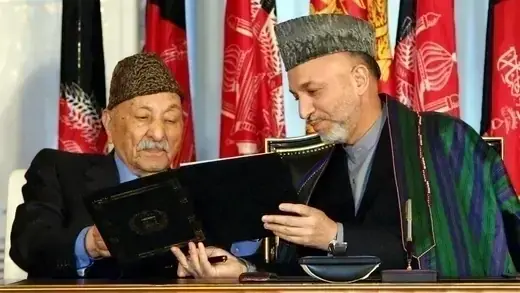
An assembly of 502 Afghan delegates agrees on a constitution for Afghanistan, creating a stiff presidential system intended to unite the country's various ethnic groups. The act is seen as a positive step toward commonwealth. "Afghans have seized the opportunity provided by the United States and its international partners to lay the foundation for democratic institutions and provide a framework for national elections," declares U.S. Ambassador to Afghanistan Zalmay Khalilzad.
A New President for Afghanistan
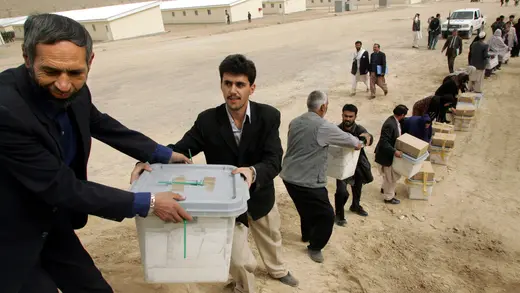
In historic national balloting, President Karzai becomes the starting time democratically elected head of Afghanistan. Voters turn out in high numbers despite threats of violence and intimidation. Karzai wins with 55 percent of the vote, while his closest rival, onetime pedagogy minister Younis Qanooni, polls 16 percentage. Karzai'southward election victory is marred past accusations of fraud by his opponents and by the kidnapping of iii foreign Un election workers by a militant group. But the ballot is still hailed as a victory for the fragile nation; Afghans had not gone to the polls since 1969, when they bandage ballots in parliamentary elections during the reign of King Mohammed Zahir Shah.
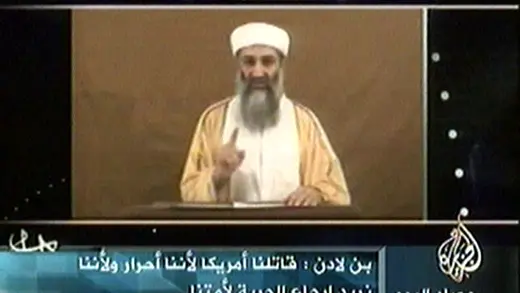
Bin Laden Surfaces
Signaling the persistent challenges facing the U.S.-led coalition in Afghanistan, bin Laden releases a videotaped message 3 weeks after the country's presidential election and just days before the U.Southward. ballot, which President Bush-league wins. In remarks aired on the Arab television network Al Jazeera, bin Laden taunts the Bush administration and takes responsibility for the attacks on September 11, 2001. "We want to restore freedom to our nation, just as you lay waste to our nation," bin Laden says.
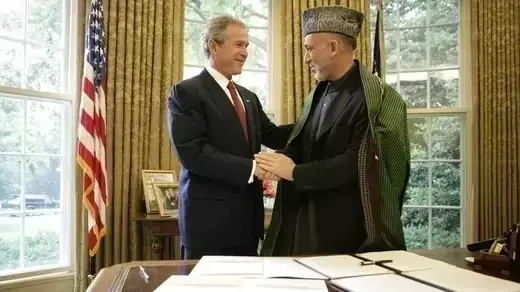
An Enduring U.S. Commitment
Afghan President Karzai and U.S. President Bush upshot a joint declaration that pronounces their respective countries strategic partners. The declaration gives U.S. forces access to Afghan military facilities to prosecute "the war against international terror and the struggle against trigger-happy extremism." The alliance's goal, the agreement says, is to "strengthen U.S.-Afghan ties and assistance ensure Transitional islamic state of afghanistan's long-term security, democracy, and prosperity." Moreover, the agreement calls for Washington to "assistance organize, train, equip, and sustain Afghan security forces as Transitional islamic state of afghanistan develops the chapters to undertake this responsibleness," and to continue to rebuild the country's economy and political democracy.
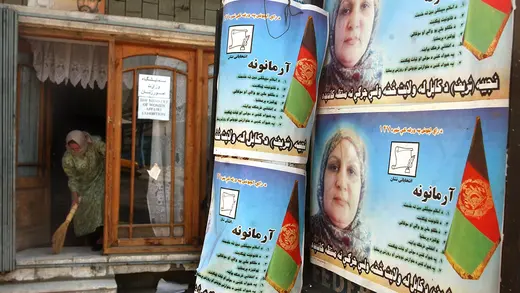
Democracy and Afghanistan
More than 6 million Afghans turn out to vote for the Wolesi Jirga (Council of People), the Meshrano Jirga (Quango of Elders), and local councils. Considered the most democratic elections ever in Afghanistan, almost half those casting ballots are women, viewed as a sign of political progress in a highly patriarchal and conservative guild. Sixty-eight out of 249 seats are set aside for female members of Afghanistan's lower house of parliament and 23 out of 102 are reserved in the upper house.
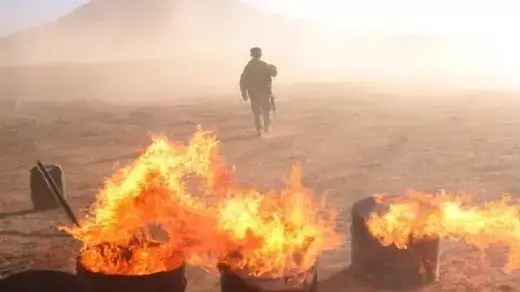
A Bloody Resurgence
Violence increases beyond the state during the summer months, with intense fighting erupting in the south in July. The number of suicide attacks quintuples from 27 in 2005 to 139 in 2006, while remotely detonated bombings more than double, to ane,677. Despite a string of recent election successes, some experts arraign a faltering central government for the spike in attacks. "As with most insurgencies, the critical precondition [to the Afghan insurgency] is the plummet of governance," says Transitional islamic state of afghanistan expert Seth G. Jones. Jones and other experts signal to the many Afghans who lack bones services, the authorities'southward difficultly setting up its constabulary forces, and the lack of international forces to aid with security.
Cracks in the Coalition
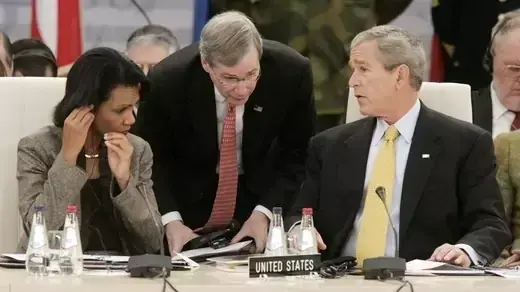
At the NATO pinnacle in Riga, Republic of latvia, rifts sally among member states on troop commitments to Transitional islamic state of afghanistan. NATO Secretary-General Jaap de Hoop Scheffer sets a target of 2008 for the Afghan National Army to begin to take command of security. "I would hope that by 2008 we will have made considerable progress," he says, "with a more stable political compages in place, and with a stiff interface betwixt NATO and the civilian agencies and effective, trusted Afghan security forces gradually taking control." Leaders of the 20-six countries agree to remove some national restrictions on how, when, and where forces can be used. But friction continues. With violence against nongovernmental aid workers increasing, U.Due south. Secretary of Defense Robert Gates criticizes NATO countries in late 2007 for not sending more than soldiers. "Our progress in Afghanistan is existent merely it is fragile," Gates says. "At this time, many allies are unwilling to share the risks, commit the resources, and follow through on collective commitments to this mission and to each other. As a result, we chance allowing what has been achieved in Afghanistan to slip away."
A Taliban Commander Falls
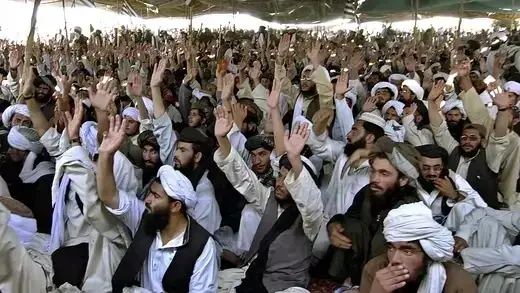
A notorious Taliban military commander, Mullah Dadullah, is killed in a joint functioning by Afghan, U.Due south., and NATO forces in the s of Afghanistan. Dadullah is believed to have been a leader of guerrilla forces in the state of war in Helmand Province, deploying suicide bombers and ordering the kidnapping of Westerners. He one time told the BBC that hundreds of suicide bombers awaited his command to launch an offensive against foreign troops.
Collateral Killings Mount
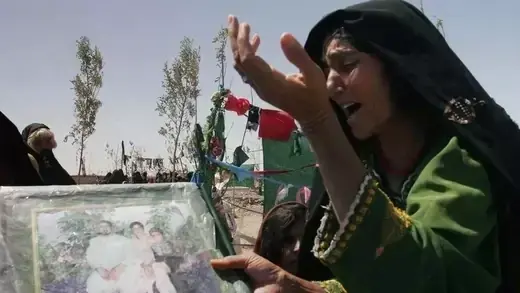
Afghan and United nations investigations notice that errant burn down from a U.S. gunship killed dozens of Afghan civilians in the Shindand District of western Herat Province, cartoon condemnation from Afghan President Karzai and bolstering Taliban claims that coalition forces are unable to protect the population. U.S. war machine officials dispute the expiry toll in this incident as well as claims that a separate incident in Farah Province left equally many as 140 civilians dead. After being named top U.S. commander in Afghanistan in mid-2009, Gen. Stanley A. McChrystal orders an overhaul of U.S. air strike procedures. "We must avert the trap of winning tactical victories, only suffering strategic defeats, by causing noncombatant casualties or excessive damage and thus alienating the people," the general writes.
Obama Recommits to Afghanistan
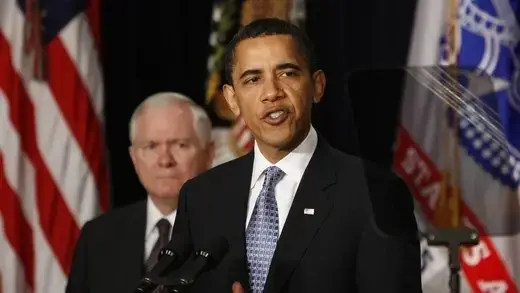
Newly elected U.S. President Barack Obama announces plans to send seventeen grand more troops to the state of war zone. Obama reaffirms campaign statements that Afghanistan is the more of import U.S. forepart against terrorist forces. He says the U.s. will stick to a timetable to draw down most gainsay forces from Iraq past the end of 2011. As of Jan 2009 the Pentagon has thirty-seven g troops in Afghanistan, roughly divided between U.S. and NATO commands. Reinforcements focus on countering a "resurgent" Taliban and stemming the flow of foreign fighters over the Afghan-Pakistan border in the south. Speaking on the troop increase, Secretary of Defence force Robert Gates describes the original mission in Afghanistan as "too wide" and calls for establishing limited goals such as preventing and limiting terrorist safe havens.
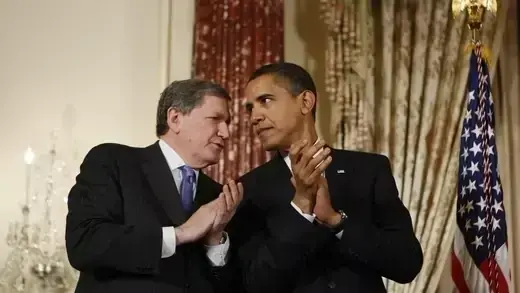
A New American Strategy
President Obama announces a new strategy for the war endeavour, linking success in Afghanistan to a stable Pakistan. The core goal of the strategy, every bit outlined in an interagency white paper, is "to disrupt, dismantle, and defeat al Qaeda and its safe havens in Pakistan, and to prevent their return to Islamic republic of pakistan or Afghanistan." The strategy urges the passage of increased assist to Pakistan and a strict standard of measuring progress in fighting al-Qaeda and the Taliban. Plans as well call for the deployment of an additional 4 thousand soldiers to assistance railroad train the Afghan army and police force force. Afghan President Karzai welcomes the strategy, stating that the programme volition bring Afghanistan and the international community closer to success.
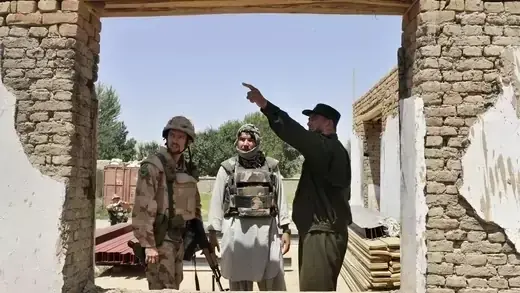
A Different Call to NATO
Senior U.Southward. military officials and commanders, altering course from the Bush assistants, telephone call on NATO nations to supply non-military assets to Afghanistan. Officials stress the need for NATO members to pace up in building Afghan civil order, such as providing resource for PRTs. A two-24-hour interval NATO summit in early April ends with a promise past NATO nations to send an boosted 5 grand troops to train the Afghan army and law force, and to provide security for the state's Baronial presidential ballot.
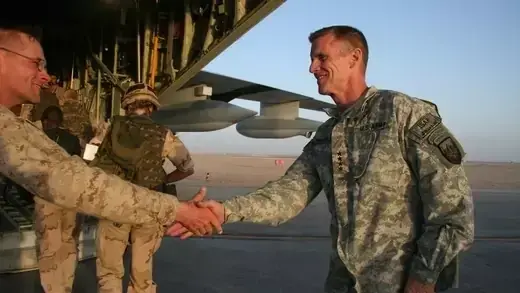
Command Change
Secretary of Defense Robert Gates replaces the meridian U.S. commander in Afghanistan, Gen. David D. McKiernan, with counterinsurgency and special operations guru Gen. Stanley A. McChrystal. McKiernan'southward removal comes xi months after he causeless control of NATO forces in Afghanistan. Gates says the Pentagon needs "fresh thinking" and "fresh eyes" on the Afghanistan war at a time when many analysts say operations there are spiraling out of control. Reports betoken that the engagement of McChrystal is intended to bring a more "aggressive and innovative" approach to the Afghan war endeavour in tune with a more than focused counterinsurgency strategy.
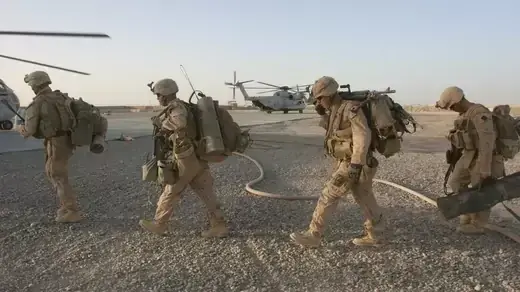
New Strategy, Old Battles
U.S. Marines launch a major offensive in southern Afghanistan, representing a major test for the U.S. armed forces's new counterinsurgency strategy. The offensive, involving four thousand Marines, is launched in response to a growing Taliban insurgency in the state'southward southern provinces, particularly Helmand Province. The operation focuses on restoring government services, bolstering local police forces, and protecting civilians from Taliban incursion. By August 2009 U.Southward. forces are to number between 60 thousand and sixty-viii m.
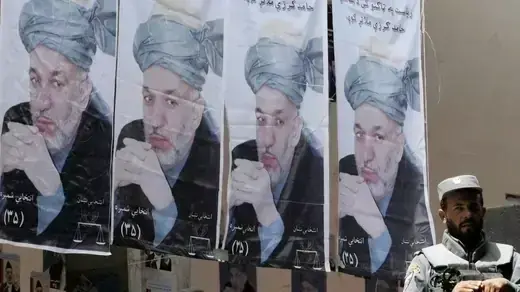
Afghan Presidential Election
After more two months of doubt following a disputed presidential election on August 20, Afghan President Karzai wins another term. The August 20 election, which pitted Karzai against top contenders Abdullah Abdullah and Ashraf Ghani, was marred past fraud allegations. An investigation by the Un-backed Electoral Complaints Commission finds Karzai won only 49.67 pct of the vote, below the fifty percent-plus-i threshold needed to avoid a runoff. Under international force per unit area, Karzai agrees to a runoff vote on November seven. But a calendar week before the runoff, Karzai'due south primary rival Abdullah pulls out, and Karzai is alleged the winner. Concerns over Karzai's legitimacy grow, and the United States and other international partners call for improved governance. U.Southward. Secretary of Land Hillary Clinton ties all future noncombatant aid to greater efforts by the Karzai administration to combat corruption.
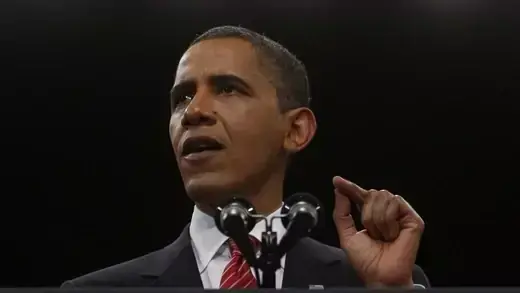
Obama's Afghan Surge
Ix months after renewing the U.S. commitment to the Afghan state of war effort, President Obama announces a major escalation of the U.S. mission. In a nationally televised speech, the president commits an additional thirty thousand forces to the fight, on top of the sixty-eight 1000 in identify. These forces, Obama says, "will increment our ability to railroad train competent Afghan Security Forces, and to partner with them and so that more than Afghans tin can get into the fight. And they will help create the atmospheric condition for the Usa to transfer responsibility to the Afghans." For the first time in the eight-year war effort, a fourth dimension frame is put on the U.S. military presence, as Obama sets July 2011 as the offset of a troop drawdown. But the president does not detail how long a drawdown will take. Obama says U.Southward. national interests are linked to success in the Afghan war effort, and argues that this temporary surge will force Afghan political and military machine institutions to assume responsibility for their own affairs.
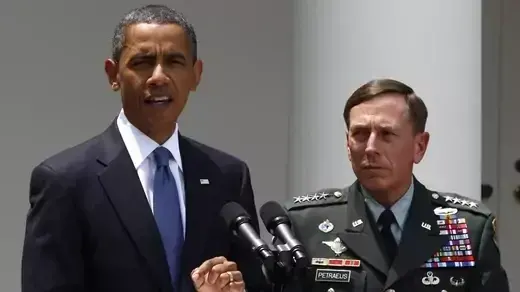
Gen. McChrystal Relieved From Afghan Control
General McChrystal is relieved of his mail service as commander of U.S. forces in Afghanistan, following a controversial Rolling Stone article in which he and his aides were quoted criticizing the administration. President Obama nominates Full general David Petraeus, head of the military machine's Central Command and architect of the 2007 Iraq surge, to supplant McChrystal. The modify in command comes at a crucial time in the war, equally boosted surge forces are scheduled to go far alee of a critical operation in Kandahar. Obama emphasizes that his acceptance of McChrystal's resignation does not reflect disagreement over the animus strategy he had helped shape. "Nosotros are in full agreement about our strategy," says Obama. "This is a change in personnel, non a modify in policy."
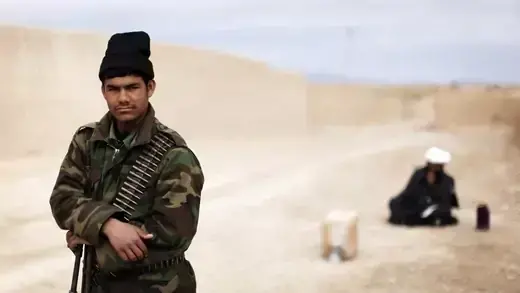
Timetable for Security Transition
At a summit in Lisbon, Portugal, NATO member countries sign a declaration agreeing to hand over total responsibility for security in Afghanistan to Afghan forces past the end of 2014. The transition process is set to brainstorm in July 2011, with local security forces taking over control in relatively stable provinces and cities. The initial handover is to coincide with the start of a drawdown in the one hundred chiliad-strong contingent of U.S. troops deployed in Afghanistan, though the number of U.S. soldiers leaving is expected to be a token amount. But many in Afghanistan and in the Due west, including members of the Afghan parliament, are concerned about the ability of national forces to take over from international troops.
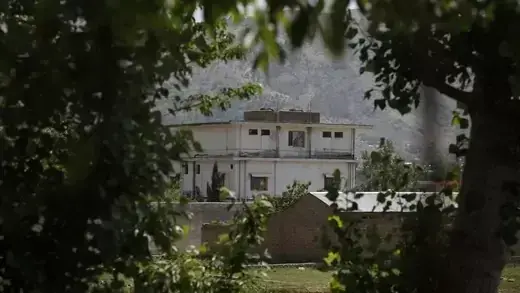
Bin Laden Killed
Al-Qaeda leader bin Laden, responsible for the nine/11 attacks, is killed by U.Southward. forces in Pakistan. The death of the United states of america' primary target for a state of war that started 10 years ago fuels the long-simmering debate well-nigh continuing the Transitional islamic state of afghanistan state of war. As President Obama prepares to denote the withdrawal of some or all of the thirty thou surge troops in July, congressional lawmakers increasingly call for a hastened drawdown of U.Southward. troops, though some analysts argue for a sustained military engagement. Meanwhile, anti-Pakistan rhetoric grows in Transitional islamic state of afghanistan, where officials accept long blamed terrorist safe havens in Islamic republic of pakistan for violence in Transitional islamic state of afghanistan. Afghan President Karzai reiterates that international forces should focus their military efforts across the edge in Islamic republic of pakistan. "For years we have said that the fight confronting terrorism is not in Afghan villages and houses," he says.
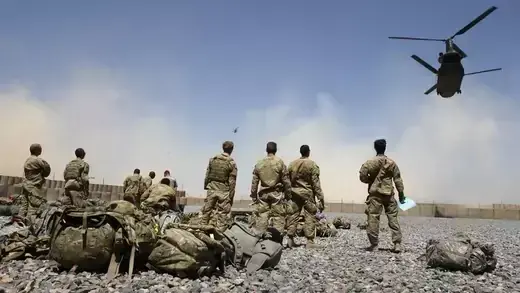
Obama Announces Troop Drawdown
President Obama outlines a program to withdraw thirty-iii thousand troops by the summer of 2012—the surge troops sent in Dec 2009—including x thousand past the stop of 2011. Polls show a tape number of Americans do not support the war, and Obama faces pressure from lawmakers, particularly Democrats, to sizably reduce U.Due south. forces in Afghanistan. Afterward the surge troops go out, an estimated seventy thousand U.Southward. troops are scheduled to stay through at to the lowest degree 2014. Obama confirms that the U.S. is holding preliminary peace talks with the Taliban leadership. With reconciliation in heed, the UN Security Quango days earlier splits a sanctions list betwixt members of al-Qaeda and the Taliban, making information technology easier to add and remove people and entities.
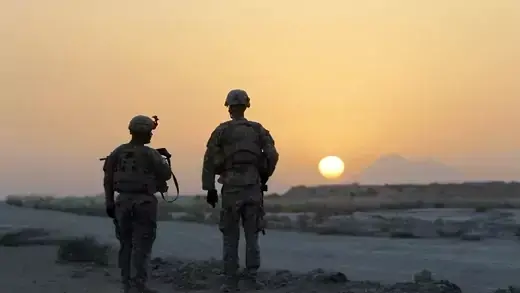
10 Years of State of war
The U.S. war in Afghanistan marks its tenth ceremony, with about hundred thou U.South. troops deployed in a animus role, primarily in southern and eastern regions. President Obama plans to withdraw all combat troops by 2014, but serious doubts remain about the Afghan government'due south capacity to secure the country. Amid a resilient insurgency, U.S. goals in Afghanistan remain uncertain and terrorist safe havens in Pakistan continue to undermine U.S. efforts. A decade in, the state of war'southward tolls include 1,800 U.Due south. troop casualties and $444 billion in spending. The costs take eroded U.S. public support, with a global economic downturn, a nine.1 per centum unemployment rate, and a $1.3 trillion annual budget deficit. While there are armed forces gains, hopes for a deal with the Taliban to assist current of air down the disharmonize remain riddled with setbacks. Afghan President Karzai suspends the talks following the September 20 assassination of Burhanuddin Rabbani, the government'south chief negotiator, which Afghan officials blame on the Pakistan-based Haqqani network. The grouping denies information technology.
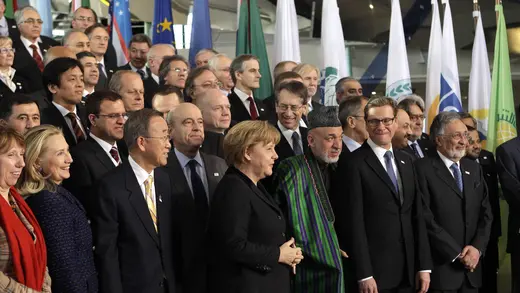
Bonn Conference
10 years after the get-go international conference that discussed Afghanistan'southward political time to come, dozens of countries and organizations meet again in Bonn, Federal republic of germany, to devise a roadmap of cooperation beyond the international troop withdrawal in 2014. Afghan President Karzai says the state will require $10 billion annually over the side by side decade to shore upward security and reconstruction, and commits to tackling corruption in commutation for continued international assistance. The conference fails to achieve its objectives—to lay down a blueprint for Afghanistan'due south transition to a self-sustaining and secure government—every bit the insurgency continues to rage, and Pakistan, a crucial player, refuses to attend.
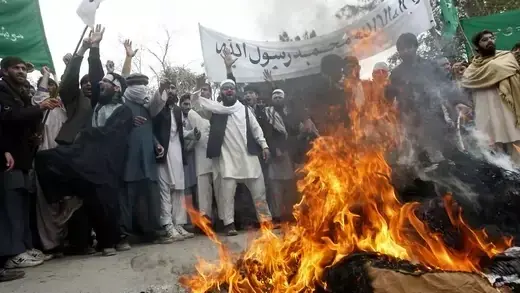
Taliban Cancel Talks; U.S.-Afghan Tensions Flare
In January, the Taliban strike a bargain to open an office in Qatar, a movement toward peace talks that the United States sees as a crucial part of a political settlement to ensure a stable Afghanistan. Only two months afterward, the Taliban suspend preliminary talks, accusing Washington of reneging on promises to take meaningful steps toward a prisoner swap. In February, U.South. Defense force Secretary Leon Panetta announces the Pentagon's program to conclude gainsay missions by equally early as mid-2013 and shift to a primarily security assistance role in Afghanistan. Meanwhile, several incidents serve equally blows to the international mission, including an accidental called-for of Qurans by U.S. troops and allegations that a U.S. soldier murdered at least sixteen Afghan villagers. Afghan President Karzai demands that foreign troops exist withdrawn from hamlet outposts and confined to military bases, which analysts say would greatly advance the footstep of transition from NATO to Afghan control.
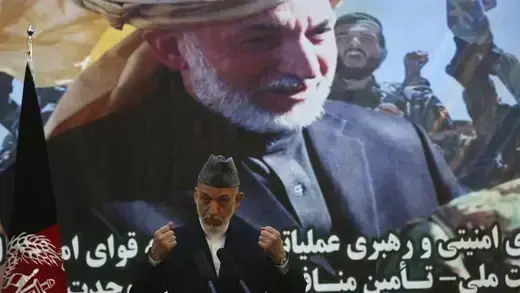
Afghan Security Takeover Completed
Afghan forces take the atomic number 82 in security responsibility nationwide as NATO hands over control of the remaining ninety-v districts. The U.S.-led coalition's focus shifts to military training and special operations-driven counterterrorism. The handover occurs on the same day every bit the declaration that Taliban representatives and U.S. officials volition resume talks in Doha, Qatar, where the Taliban take just opened an role. Afghan President Karzai, believing the office will confer legitimacy on the insurgent group and serve as a diplomatic outpost, suspends negotiations with the The states. With its mandate expiring in Dec 2014, the United States must negotiate a bilateral security agreement with the Karzai regime to maintain a military presence.
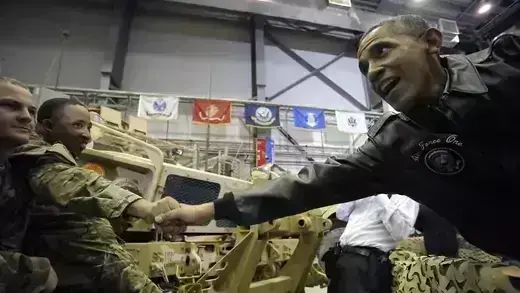
Obama Announces U.S. Troop Withdrawal
President Obama announces a timetable for withdrawing most U.Due south. forces from Transitional islamic state of afghanistan by the end of 2016. The first phase of his program calls for 9,800 U.S. troops to remain after the combat mission concludes at the end of 2014, limited to preparation Afghan forces and conducting operations against "the remnants of al-Qaeda." Obama says the drawdown will free resources for counterterrorism priorities elsewhere. Some analysts betoken to the insurgency'south resilience and question the plan'southward rigidity. Both candidates vying to succeed Afghan President Karzai have promised to sign the security understanding that is a prerequisite of whatsoever post-2014 U.S. troop presence.
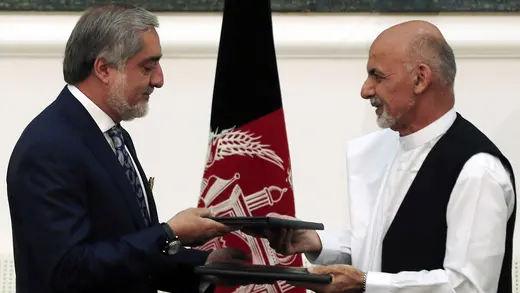
Ghani, Abdullah Agree to Unity Government
Newly elected Afghan President Ghani signs a power-sharing agreement with his primary opponent, Abdullah, who had mobilized thousands of protesters as he challenged the voting results. The agreement, brokered after intensive diplomacy by U.S. Secretarial assistant of Land John Kerry, establishes the role of chief executive for Abdullah. While the agreement staves off ceremonious unrest, it ushers in protracted authorities dysfunction as Ghani and Abdullah tussle over their respective prerogatives, such as appointments to security posts, at a time when the Taliban are making gains in the countryside. Ghani, a old World Banking concern specialist, is a Pashtun from the land'south s, like Karzai, but is seen past the Obama administration as a welcome change. Karzai had railed against noncombatant casualties in the U.S. war try and was seen every bit fostering public abuse.
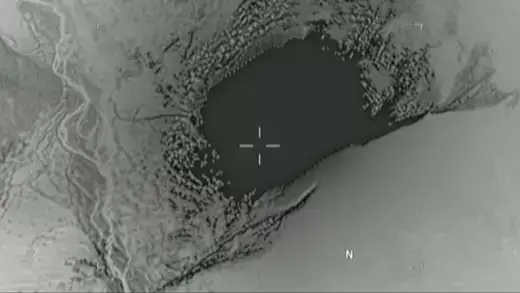
U.Southward. Attacks Islamic Country Redoubt
The United States drops its most powerful non-nuclear flop on suspected self-proclaimed Islamic State militants at a cave complex in eastern Nangarhar Province. The weapon, known colloquially as "the mother of all bombs," comes every bit newly elected President Donald Trump delegates controlling regime to commanders, including the possibility of adding several thousand U.South. troops to the nearly nine thousand already deployed there. (There are virtually as many U.South. contractors every bit well.) The bombing casts a spotlight on the emergence of the Islamic Country in Afghanistan. At the same fourth dimension, the Taliban appear to exist as strong as ever, and the U.S. military describes the war equally a stalemate. Kabul experiences suicide bombings [PDF] on a scale never before seen, while the Taliban control or contest more than a third [PDF] of the country. U.Due south. Marines are once over again dispatched to Helmand Province.
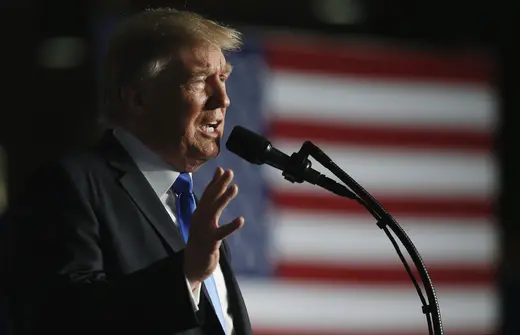
Trump Signals Prolonged Afghan War
President Trump outlines his Afghanistan policy in an address to troops in Arlington, Virginia, saying that though his "original instinct was to pull out," he will instead press ahead with an open-concluded military commitment to prevent the emergence of "a vacuum for terrorists." Differentiating his policy from Obama's, Trump says decisions near withdrawal will be based on "conditions on the ground," rather than arbitrary timelines. He invites India to play a greater role in rebuilding Transitional islamic state of afghanistan while castigating Pakistan for harboring insurgents. He besides pledges to loosen restrictions on combat fifty-fifty as the United Nations reports an uptick [PDF] in civilian casualties caused by Afghan and coalition air strikes. A political settlement with the Taliban, Trump says, is far off.
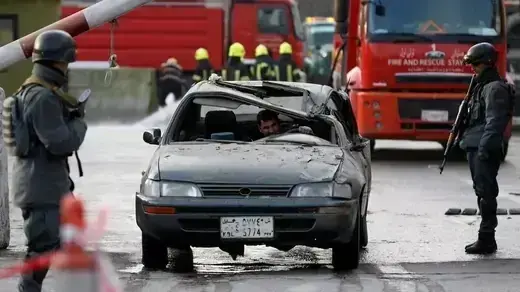
Taliban Launch Major Attacks Amidst U.S. Escalation
The Taliban carry out a series of bold terror attacks in Kabul that kill more than than 115 people amid a broader upsurge in violence. The attacks come up equally the Trump administration implements its Transitional islamic state of afghanistan plan, deploying troops beyond rural Afghanistan to suggest Afghan brigades and launching air strikes against opium labs to try to decimate the Taliban's finances. The administration also cuts off security assistance worth billions of dollars to Islamic republic of pakistan for what President Trump called its "lies and deceit" in harboring Taliban militants. Critics of the National Unity Government say domestic politics—notably a showdown with a provincial governor—have distracted Afghan President Ghani from security.
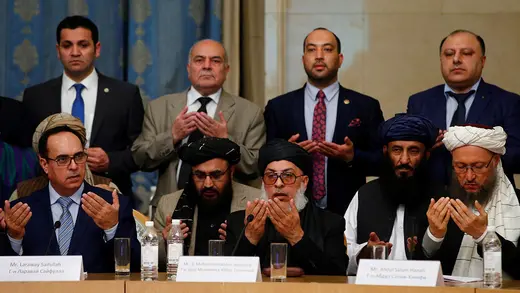
U.Southward.-Taliban Peace Talks Progress
Negotiations between the United States and the Taliban in Doha enter their highest level yet, edifice on momentum that began in belatedly 2018. The talks between U.S. special envoy Zalmay Khalilzad and tiptop Taliban official Mullah Abdul Ghani Baradar center on the U.s.a. withdrawing its troops from Afghanistan in exchange for the Taliban pledging to block international terrorist groups from operating on Afghan soil. The ramped-upwardly diplomacy follows signals that President Trump plans to pull out seven m troops, about one-half the total U.S. deployment. Khalilzad says the United States volition insist that the Taliban concord to participate in an intra-Afghan dialogue on the country's political structure, as well as a cease-fire. It is unclear whether Trump will status the troop withdrawal on those terms.
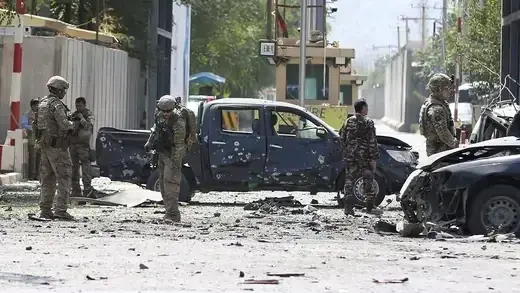
Trump Calls Off Peace Talks
President Trump abruptly breaks off peace talks a week after summit U.S. negotiator Khalilzad announced that an agreement had been reached "in principle" with Taliban leaders. In a tweet, Trump says he canceled a undercover meeting with the Taliban and Afghan President Ghani at Army camp David after a U.S. soldier was killed in a Taliban attack. The Taliban say they are "committed to continuing negotiations," simply warn that the counterfoil volition cause an increase in the number of deaths.
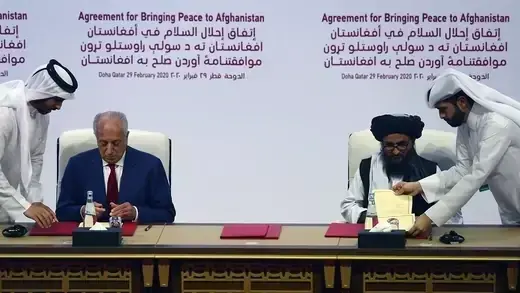
U.S., Taliban Sign Deal on Path to Peace
U.South. envoy Khalilzad and the Taliban's Baradar sign an agreement [PDF] that paves the way for a pregnant drawdown of U.Due south. troops in Afghanistan and includes guarantees from the Taliban that the country will non be used for terrorist activities. The deal says intra-Afghan negotiations should brainstorm the post-obit month, but Afghan President Ghani says the Taliban must meet his government'south ain weather condition earlier it enters talks. The U.S.-Taliban deal doesn't call for an immediate cease-burn down, and in the days after its signing, Taliban fighters carry out dozens of attacks on Afghan security forces. U.S. forces reply with an air strike against the Taliban in the southern province of Helmand.
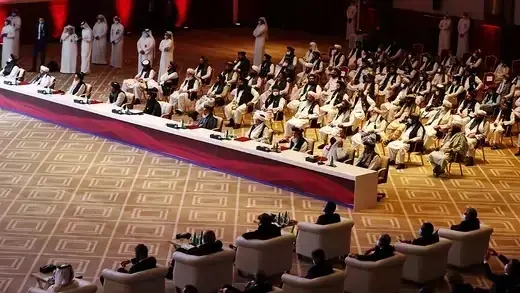
Intra-Afghan Peace Talks Begin
Representatives of the Taliban and of the Afghan government and ceremonious society meet face to confront for the first time in Doha, Qatar, afterwards nigh xx years of war. The direct negotiations, which were delayed for months over a prisoner bandy proposed in the earlier U.S.-Taliban deal, begin after the Afghan authorities completes the release of five m Taliban prisoners. During opening remarks, both sides express eagerness to bring peace to Afghanistan and plant a framework for Afghan society afterward U.Due south. troops withdraw. The government pushes for a finish-fire, while the Taliban reiterate their call for the country to exist governed through an Islamic organisation.
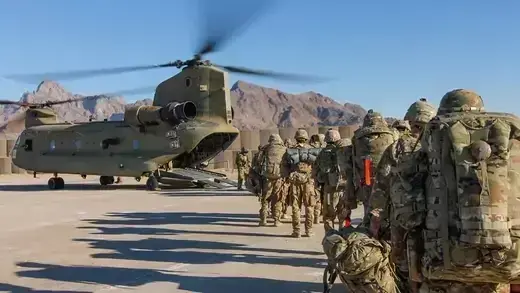
U.S. Announces Troop Withdrawal
Acting U.Due south. Defense Secretary Christopher C. Miller announces plans to halve the number of troops in Afghanistan to 2,500 by mid-January, days before President-Elect Joe Biden will be inaugurated. Thousands of troops had already been pulled out following an agreement with the Taliban in February, moving closer to fulfilling President Trump's campaign promise to end the then-called forever wars. The announcement comes every bit negotiations betwixt the Afghan government and the Taliban are deadlocked and the militant grouping continues to launch mortiferous attacks. NATO Secretarial assistant-General Jens Stoltenberg warns that withdrawing troops too early on could permit Transitional islamic state of afghanistan to go a oasis for terrorists and the Islamic Land to rebuild its caliphate.
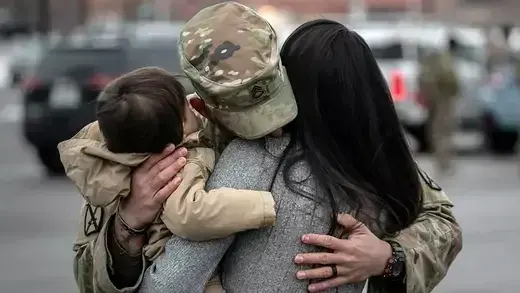
Biden Decides on Complete U.South. Withdrawal by ix/11
President Biden announces that the Us will not meet the borderline set under the U.S.-Taliban agreement to withdraw all troops past May 1 and instead releases a plan for a total withdrawal past September eleven, 2021. "Information technology's time to cease America's longest state of war," he says. The remaining 3,500 troops in Afghanistan will be withdrawn regardless of whether progress is made in intra-Afghan peace talks or the Taliban reduce their attacks on Afghan security forces and citizens. NATO troops in Afghanistan volition too get out. Biden says Washington will keep to help Afghan security forces and back up the peace process. The Taliban say they will not participate in "whatever conference" on Transitional islamic state of afghanistan's futurity until all foreign troops get out.
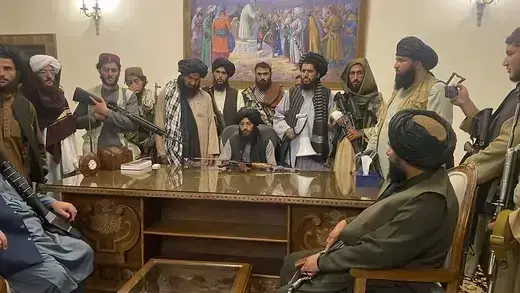
Afghan Regime Collapses as the Taliban Accept Kabul
Facing niggling resistance, Taliban fighters overrun the capital, Kabul, and take over the presidential palace hours after President Ghani leaves the state. Taliban leaders say they will hold talks with Afghan officials to form an "open, inclusive Islamic government." Former Afghan President Karzai and Abdullah, formerly the chief executive nether Ghani, create a council to facilitate a peaceful transition to a Taliban government. The takeover follows the Taliban'south rapid advance, during which they captured all just two of Afghanistan's provincial capitals and seized border crossings. Afghan security forces in some areas reportedly negotiated surrenders and avoided fighting the Taliban.
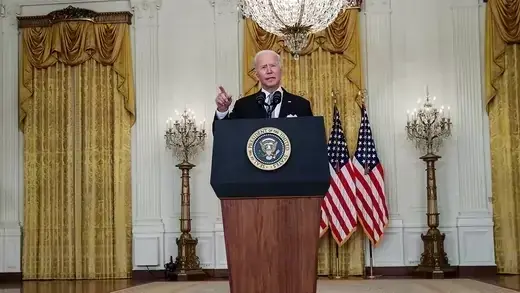
Biden Defends Withdrawal
President Biden says his administration made the right decision in ending U.S. military interest in Afghanistan, arguing that the U.S. counterterrorism mission is complete. But he acknowledges that the troop withdrawal has been "messy" and blames Afghan security forces for failing to counter the Taliban. Meanwhile, the Us deploys six thousand troops to evacuate U.S. and allied personnel and secure Kabul'south international airport, where anarchy erupts equally thousands of Afghans attempt to flee. Biden says the military volition aid evacuate thousands of Afghans who worked with the United states of america, and he expands refugee-status admission for vulnerable Afghans.
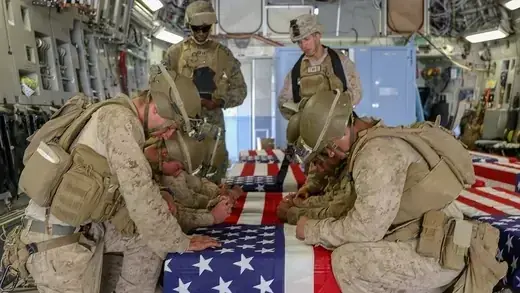
Xiii U.Due south. Service Members Killed Amid Scramble to Withdraw
13 U.S. service members are killed and at least eighteen are injured in an assail at a checkpoint outside the Kabul aerodrome, where thousands of people are being evacuated. They are the kickoff U.S. service members killed in activity in Afghanistan since February 2020. At to the lowest degree 170 Afghans are also killed. The Islamic State in Khorasan claims responsibility, and several days after, the United States launches an air strike targeting a suspected plotter from the group. However, the Pentagon later admits that the strike was a "fault" and killed ten civilians, including seven children.
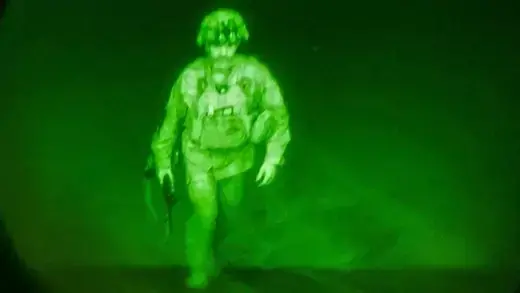
Xx-Yr War Ends every bit U.S. Completes Withdrawal
The last U.South. military machine forces depart Afghanistan, leaving information technology nether Taliban rule. The get out follows a chaotic, two-week withdrawal procedure during which more than 120,000 people are evacuated. The side by side day, President Biden says the United States should acquire from its mistakes and that the withdrawal marks the end of "an era of major military operations to remake other countries." Thousands of Afghans who assisted the United States and its allies, as well equally up to two hundred Americans, remain in Afghanistan. U.S. Secretarial assistant of State Antony Blinken says Washington volition work to get them out and that future U.Due south. engagement in Transitional islamic state of afghanistan will focus on diplomacy.
wilsonancticipse1966.blogspot.com
Source: https://www.cfr.org/timeline/us-war-afghanistan
0 Response to "A Strong Ally of the United States in 2001 Agains the Taliban Is What"
Post a Comment